
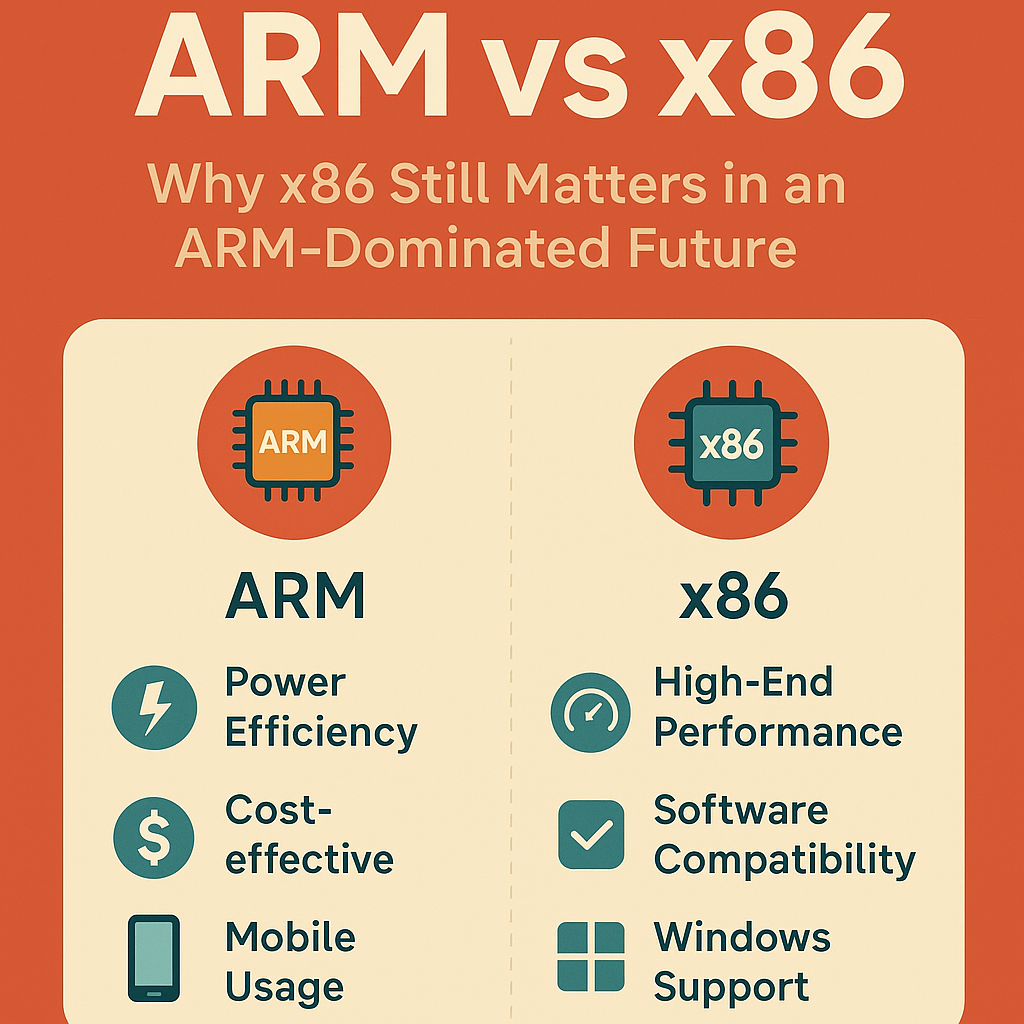
Overview Table: ARM vs x86 Processors
| Aspect | ARM Architecture | x86 Architecture |
|---|---|---|
| Design Philosophy | Reduced instruction set computing | Complex instruction set computing |
| Power Efficiency | High efficiency, low power usage | Traditionally higher power usage |
| Performance Focus | Performance per watt | Raw performance and compatibility |
| Common Devices | Smartphones, tablets, laptops, servers | PCs, laptops, workstations, servers |
| Instruction Set | RISC-based | CISC-based |
| Software Compatibility | Growing native ecosystem | Vast legacy software base |
| Manufacturing Model | Licensed to multiple vendors | Controlled by limited manufacturers |
| Future Direction | Expansion into high-performance computing | Efficiency optimization and specialization |
Introduction to the CPU Architecture Debate
The modern computing world is built on processors, and at the heart of this foundation lies a long-running architectural divide: ARM vs x86. These two processor families power nearly every digital experience, from smartphones and laptops to servers, data centers, and embedded systems. While both aim to execute instructions efficiently, they originate from fundamentally different design philosophies that shape performance, power consumption, scalability, and future potential.
For decades, ARM vs x86 dominated personal computing and enterprise servers, while ARM became synonymous with mobile and low-power devices. Today, this clear separation is dissolving. ARM processors are entering laptops, desktops, and servers, while x86 continues to optimize power efficiency and expand into new form factors. This convergence has transformed the ARM vs x86 discussion from a niche technical comparison into a central question about the future of computing itself.
This article delivers a comprehensive, experience-driven, and technically grounded exploration of ARM vs x86 processors. It examines their histories, architectural differences, performance characteristics, software ecosystems, real-world applications, and future trajectories, offering a balanced journalistic analysis of where CPU technology is heading.
Historical Evolution of ARM vs x86
Origins of x86 Architecture
The x86 architecture traces its roots to early personal computing. Designed with backward compatibility in mind, x86 evolved through incremental improvements rather than radical redesigns. Each generation added new instructions and capabilities while maintaining support for older software.
This commitment to compatibility allowed x86 to dominate desktops, laptops, and enterprise systems. Software developers built vast ecosystems around x86, reinforcing its position as the default computing platform for decades.
Emergence of ARM Architecture
ARM originated with a different goal: simplicity and efficiency. Designed initially for embedded systems, ARM focused on reduced instruction sets that could be executed quickly with minimal power consumption. This approach made ARM ideal for battery-powered devices.
As mobile computing exploded, ARM’s advantages became increasingly valuable. Smartphones, tablets, and wearable devices relied on ARM processors to deliver acceptable performance while maximizing battery life.
Diverging Paths and Eventual Convergence
For many years, x86 and ARM occupied distinct markets. However, advances in manufacturing, microarchitecture, and system design began to blur these boundaries. ARM grew more powerful, while x86 became more efficient, setting the stage for direct competition.
Architectural Foundations Explained
RISC and CISC Philosophies
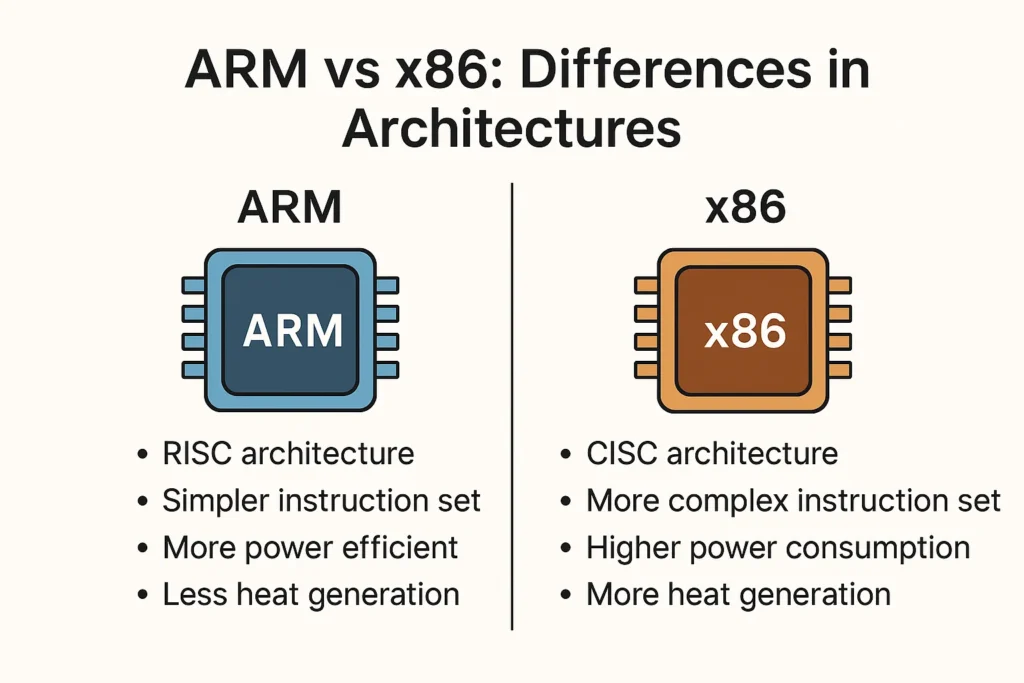
ARM processors are based on the Reduced Instruction Set Computing approach. This philosophy emphasizes a smaller set of simple instructions that execute quickly and predictably. Simplicity enables efficient pipelines and lower power consumption.
x86 processors follow the Complex Instruction Set Computing model. They support a wide range of instructions, some performing complex operations in a single command. While this increases instruction complexity, modern x86 processors internally translate these instructions into simpler operations.
Instruction Decoding and Execution
ARM’s streamlined instruction decoding reduces overhead and improves energy efficiency. x86 processors require more complex decoding logic, which historically increased power consumption but also enabled powerful features and backward compatibility.
Modern x86 designs mitigate complexity through advanced decoding and execution engines, narrowing the efficiency gap with ARM.
Microarchitecture Innovations
Both ARM vs x86 leverage sophisticated microarchitectural techniques such as out-of-order execution, speculative execution, and deep pipelines. These innovations reduce the practical differences between RISC and CISC at the execution level.
The competition now centers more on implementation quality than instruction set philosophy alone.
Performance Characteristics and Trade-Offs
Raw Performance Capabilities
x86 processors have traditionally excelled in raw performance, particularly in high-frequency workloads and complex applications. Desktop and server CPUs built on x86 deliver exceptional single-thread and multi-thread performance.
ARM processors, once considered underpowered for demanding tasks, have closed the gap significantly. Modern ARM designs demonstrate impressive performance, challenging x86 in everyday computing and even professional workloads.
Performance per Watt
Performance per watt is where ARM vs x86 has historically led. Efficient execution and power-conscious design allow ARM processors to deliver strong performance with lower energy consumption.
x86 manufacturers have responded by optimizing power efficiency, particularly in mobile and server environments, reducing the traditional advantage held by ARM.
Thermal and Sustained Performance
ARM processors often maintain stable performance over long periods due to lower heat generation. x86 processors can deliver higher peak performance but may throttle under sustained loads depending on cooling solutions.
This distinction influences device design, particularly in thin and fanless systems.
Power Efficiency and Energy Management
Importance of Power Efficiency
Power efficiency affects battery life, thermal design, and operational cost. In mobile and large-scale computing, energy efficiency is not merely a convenience but a critical economic factor.
ARM’s efficiency-first design aligns naturally with these requirements, making it attractive for a wide range of applications.
Advances in x86 Power Optimization
x86 processors now incorporate advanced power management techniques, including dynamic frequency scaling, core parking, and workload-aware scheduling. These improvements significantly reduce idle and low-load power consumption.
As a result, x86 systems are increasingly competitive in energy-sensitive environments.
Impact on Data Centers
In data centers, power efficiency translates directly into cost savings. ARM-based servers offer compelling efficiency advantages, particularly for scale-out workloads and cloud services.
x86 remains dominant due to software compatibility and mature ecosystems but faces increasing competition as energy costs rise.
Manufacturing and Business Models
ARM Licensing Model
ARM licenses its architecture to multiple manufacturers, enabling a diverse ecosystem of designs. Companies can customize processors for specific workloads, resulting in a wide range of performance and efficiency profiles.
This model encourages innovation and rapid iteration, allowing ARM-based solutions to target niche and mainstream markets alike.
x86 Controlled Ecosystem
x86 architecture is controlled by a limited number of manufacturers, resulting in a more centralized development approach. This control ensures consistency and compatibility but can limit diversity.
The concentrated ecosystem has historically driven stability and predictability, particularly for enterprise customers.
Impact on Innovation
ARM’s open licensing fosters experimentation and specialization, while x86’s controlled model emphasizes refinement and reliability. Both approaches influence how quickly new ideas reach the market.
Software Ecosystem and Compatibility
Legacy Software Advantage of x86
One of x86’s greatest strengths is its extensive software ecosystem. Decades of applications, operating systems, and tools are optimized for x86, creating strong inertia.
This compatibility remains a decisive factor for businesses and professionals who rely on specialized software.
ARM Software Maturity
ARM’s software ecosystem has grown rapidly, particularly in mobile and cloud environments. Native applications and optimized operating systems now support a wide range of use cases.
Compatibility layers and emulation technologies further reduce barriers to adoption, though performance may vary.
Developer Considerations
Developers increasingly target multiple architectures, using cross-platform tools and frameworks. This trend reduces architectural lock-in and accelerates ARM adoption in traditional computing spaces.
ARM vs x86 in Consumer Devices
Smartphones and Tablets
ARM dominates mobile devices due to its efficiency and integration capabilities. System-on-chip designs combine CPU, GPU, and specialized accelerators into a single package.
x86 has largely retreated from this space, focusing on areas where its strengths are more relevant.
Laptops and Personal Computers
ARM-based laptops emphasize battery life and silent operation, appealing to productivity-focused users. x86 laptops offer a broader range of performance options and compatibility.
Consumer choice increasingly depends on usage patterns rather than architectural loyalty.
Desktops and Workstations
x86 remains strong in desktops and workstations, particularly for demanding tasks such as content creation and engineering. ARM’s presence is growing but remains limited in this segment.
Enterprise and Server Computing
Cloud and Hyperscale Adoption
ARM-based servers attract cloud providers seeking efficiency and scalability. Workloads such as web services, microservices, and containerized applications benefit from ARM’s characteristics.
x86 continues to dominate enterprise servers due to established software stacks and performance leadership.
Specialized Workloads
Certain workloads favor one architecture over the other. ARM excels in parallel, scale-out tasks, while x86 performs well in compute-intensive, legacy-heavy environments.
Hybrid data centers increasingly deploy both architectures.
Cost and Total Ownership
Total cost of ownership includes hardware, power, cooling, and maintenance. ARM vs x86 efficiency can reduce operational costs, influencing long-term deployment decisions.
Security Considerations
Architectural Security Features
Both ARM vs x86 incorporate hardware-level security features designed to protect against modern threats. These include secure enclaves, trusted execution environments, and virtualization support.
Security effectiveness depends on implementation and software integration rather than architecture alone.
Vulnerabilities and Mitigations
Past vulnerabilities have affected both architectures, highlighting the complexity of modern CPUs. Ongoing research and mitigation strategies are critical to maintaining trust.
Security is increasingly a shared responsibility between hardware, firmware, and software layers.
The Role of Specialized Accelerators
Beyond General-Purpose CPUs
Modern computing increasingly relies on specialized accelerators for tasks such as graphics, machine learning, and encryption. Both ARM vs x86 platforms integrate these accelerators to enhance performance.
The CPU’s role shifts toward orchestration and coordination rather than executing all tasks directly.
ARM’s Integration Advantage
ARM-based designs often integrate accelerators tightly with the CPU, improving efficiency and reducing latency. This integration aligns with modern heterogeneous computing trends.
x86 systems also adopt accelerators but may rely more on discrete components.
Market Trends and Industry Momentum
Shifting Industry Perceptions
ARM is no longer viewed solely as a low-power alternative. Its presence in high-performance computing reshapes industry perceptions and investment strategies.
x86 adapts by emphasizing versatility, performance leadership, and ecosystem strength.
Influence of Major Technology Companies
Large technology companies influence CPU adoption through platform choices and software optimization. Their decisions accelerate or slow architectural transitions.
This influence shapes market dynamics and future development priorities.
Future Outlook for ARM vs x86
Convergence Rather Than Replacement
The future is likely defined by coexistence rather than dominance by a single architecture. ARM vs x86 each address different priorities and workloads.
Hybrid environments that leverage both architectures are becoming increasingly common.
Innovation Drivers
Advances in manufacturing, packaging, and architecture will continue to push performance and efficiency forward. Competition between ARM vs x86 accelerates innovation across the industry.
Emerging workloads such as artificial intelligence and immersive computing will further influence CPU design.
Long-Term Implications
CPU architecture choices impact software development, hardware design, and energy consumption on a global scale. The ARM vs x86 debate reflects broader shifts toward efficiency, specialization, and adaptability.
Final Perspective on the Future of CPUs
ARM vs x86 represent two distinct yet converging visions of computing. ARM vs x86 efficiency-driven, flexible model challenges traditional assumptions about performance and power, while x86’s legacy strength and continuous optimization sustain its relevance across critical domains.
The future of CPUs is not a zero-sum contest but a dynamic balance shaped by use cases, economics, and innovation. As computing demands evolve, both ARM vs x86 will continue to adapt, influencing how devices are built and how digital experiences are delivered.
Understanding this architectural competition provides insight into the direction of technology itself, where efficiency, performance, and adaptability define the next era of computing.
